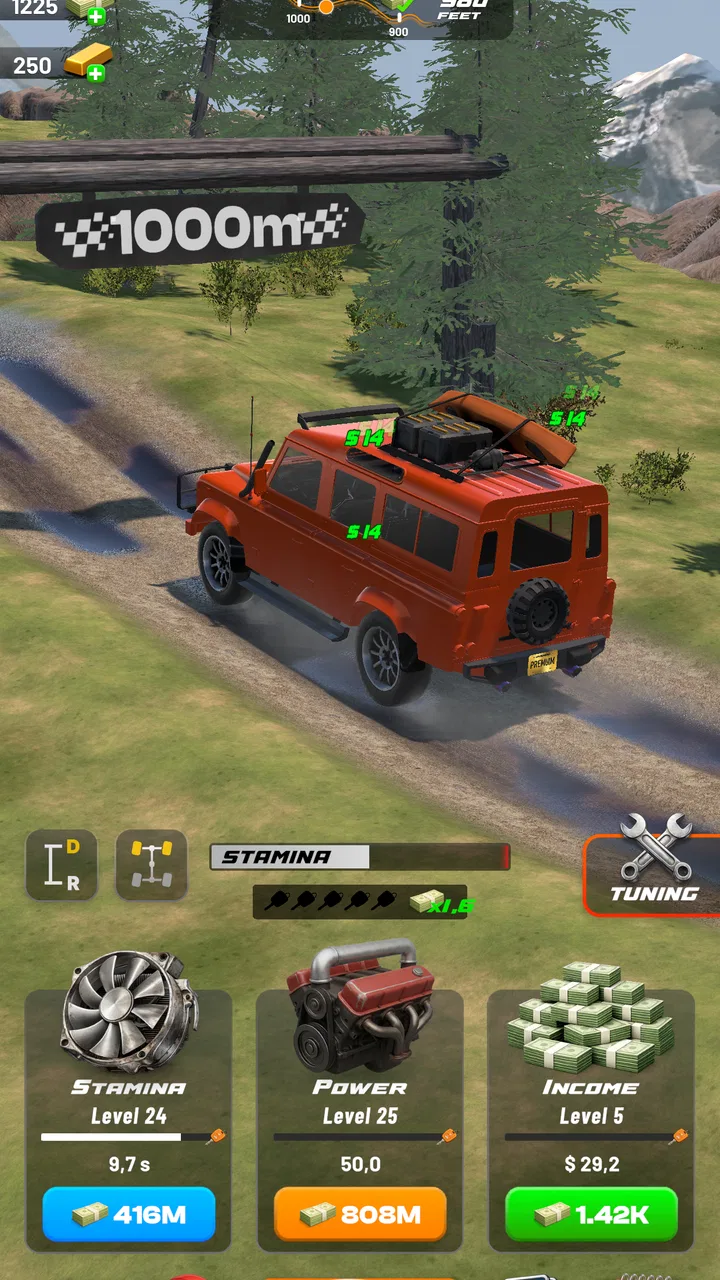
Drive 2 Climb: Offroad 4x4
- 4.2
- Rating
- 1.00M
- Installs
- Free
- Price

 Analysis by App-foxy
I approached Drive 2 Climb: Offroad 4x4 expecting a straightforward mobile racing game, but its most interesting quality is the way it makes climbing feel like the main event rather than a brief obstacle between races. Developed by HyperMonk Games, this free Android title puts the focus on driving through rough terrain and finding enough control to keep moving upward. The store summary says “Drive. Earn. Climb Higher,” and that idea is a fair description of the game’s central rhythm without telling the whole story.
My impression is that this is best understood as an off-road driving game for short, hands-on sessions. It is not trying to replace a large console-style racing experience, and it does not have the same appeal as a polished circuit racer built around perfect lap times. Instead, the pleasure comes from managing a vehicle over uneven ground, reacting to changes in the route, and deciding how aggressively to push when a climb starts to go wrong.
Why the climbing-focused driving matters
The key capability here is terrain-based progression. In a normal racing game, the road usually exists to help you build speed. In Drive 2 Climb: Offroad 4x4, the terrain itself becomes the problem to solve. A steep section, a rough surface, or a badly timed movement can interrupt your momentum, so simply holding the accelerator is not always the smartest approach.
You May Also Like

 Blood Strike: 2.5 Anniversary
Blood Strike’s Loadouts Turn Every Drop Into a Tactical Gamble
A close look at Blood Strike’s custom loadouts: how fast access to signature weapons reshapes its battle royale rhythm, rewards preparation, and narrows the gap between fights.

 Pandora - Music & Podcasts
Pandora’s Music Is Easy to Start, but Harder to Recover
Pandora’s strength is its low-effort path from a seed to a station. Its weak spot is how much confidence it asks you to place in connection, setup, and quiet recovery.

 8 Ball Pool
 Is Built on Rivalries, Rematches, and Routine
A close look at the rivalries, rematches, shared routines, and unanswered safety questions that turn a quick pool match into a persistent mobile community.

 Samsung Music
’s Quiet Strength Is Playing What You Already Own
Its reach comes less from spectacle than from dependable access to a personal library. That simplicity is both the app’s strongest retention engine and its ceiling.

 AccuWeather: Weather Radar
AccuWeather Review: A Quick, Clear Forecast for Everyday Decisions
For everyday plans, the best forecast is the one you can understand quickly. AccuWeather makes rain timing, radar, and local conditions easy to act on, with a few trade-offs.

 Hill Climb Racing
Why Hill Climb Racing Still Turns Crashes Into One More Run
A tiny car, a bumpy hill and one more upgrade: Hill Climb Racing keeps resurfacing because its simple chaos makes every near-miss feel personal.
More From Our News Desk
View All News


That changes the way I play. I pay more attention to the vehicle’s position and movement instead of looking only at the finish. When the route rises, I think about preserving control first and speed second. That sounds simple, but it gives the game a different mood from a typical arcade racer. The goal is not just to be fast; it is to stay composed long enough to make the climb worthwhile.
This focus also makes the game approachable for people who do not usually enjoy racing games. You do not need to memorize a circuit or understand complicated tuning terminology to appreciate what is happening. The basic question is immediate: can I keep the vehicle moving over this section, or did I approach it badly? That clarity is one of the game’s strongest qualities.
At the same time, the climbing idea creates a limitation. Players looking for traffic battles, realistic motorsport rules, or a deep collection of licensed cars may find the experience too narrow. The game’s identity depends on its off-road challenge, so it is more satisfying when you want a compact driving task than when you want a broad racing simulation.
How the control challenge feels during a run
In practice, I found that small decisions matter more than dramatic ones. A common mistake is to treat every section as an invitation to accelerate. On a difficult rise, that can leave the vehicle poorly positioned or make a recovery harder. I get better results when I enter a climb with a little patience, keep my movement deliberate, and avoid turning a manageable problem into a complete loss of momentum.
That is also where the game can feel more thoughtful than its simple presentation suggests. The best runs are not necessarily the ones where I take the most risks. They are the ones where I recognize when a section demands steady progress and when I can afford to be more aggressive. The difference is subtle, but it gives repeated attempts a purpose beyond simply trying again.
My practical tip is to treat each climb as a sequence of smaller decisions. Before pushing forward, I consider whether the vehicle is lined up well, whether I have enough room to correct a mistake, and whether a faster approach would actually help. This habit is more useful than chasing speed at every moment, especially during the first sessions when the terrain is still unfamiliar.
Another useful approach is to separate learning from earning. Early attempts are valuable even when they do not produce the best result, because they show where momentum disappears and which parts of the route deserve caution. Once I understand those trouble spots, I can make a more deliberate run instead of repeating the same mistake with more confidence.
The game’s progression loop supports that mindset through the relationship between driving, earning, and climbing. I do not see the reward as a reason to rush every attempt. It is more useful as feedback: a careful run that reaches farther can be more satisfying than a reckless run that starts quickly but collapses before the important section.
The best everyday scenario for playing
This is the sort of game I would keep for small gaps in the day. Imagine waiting for a takeaway order, sitting through a short commute as a passenger, or taking a break between tasks. A climb-focused run gives me a clear objective without demanding the long attention span of a full racing session. I can play for a few minutes, put the phone away, and return later without feeling that I abandoned a complicated event.
That short-session strength is especially useful on a phone with an older operating system, since the game supports Android 7.1 and later. The age rating is Everyone, which also makes it easier to consider for a shared family device, although younger players may still need guidance around the optional purchases. The game is free to install, but in-app items range from $0.99 to $99.99, so I would check purchase settings before handing the device to a child.
For an adult player, the same scenario works differently. I might use one attempt to unwind after work, then spend another attempt trying to improve a specific part of the climb. Because the challenge is concentrated in driving control, I do not need to prepare a long session or remember a detailed storyline. The game gets to the point quickly, which is a real advantage when my free time is unpredictable.
It is less suitable when I want a social activity on the same screen, a long career mode, or a strong simulation of real-world racing. In those situations, a conventional circuit racer or a more feature-heavy off-road game would probably give me more variety. This title works best when the physical act of getting uphill is enough to hold my attention.
Where it differs from ordinary racing alternatives
Compared with a standard arcade racer, the game places less emphasis on overtaking and more on maintaining a usable line across difficult ground. In a circuit racer, a mistake may cost a corner or a position. Here, a mistake can affect the entire rhythm of the climb. That makes the experience slower in thought, even when the action itself remains quick.
Compared with a realistic 4x4 simulation, it is easier to understand and faster to start. I do not need to approach it like a technical driving lesson. The trade-off is that players who enjoy detailed vehicle setup, highly realistic handling, or extensive mechanical customization may want something deeper. The appeal is not complexity for its own sake; it is the immediate feedback from trying to get over the next difficult section.
Compared with endless driving games, the climbing objective gives my attempts a clearer shape. I am not simply surviving until I make an error. I am working toward a higher point and trying to improve the way I reach it. That makes the game more purposeful, although it can also make repetition more noticeable if the available challenge does not keep feeling fresh for you.
The current version is 0.2.7, and that matters to my expectations. I treat the game as an experience that is still developing rather than as a finished, expansive racing package. That does not prevent it from being enjoyable now, but it does mean I would judge it primarily on the quality of its core driving loop instead of expecting the breadth of a long-established franchise.
The trade-offs behind the simple design
The cleanest benefit of the design is accessibility. I can understand the objective almost immediately, and the game does not bury the central challenge under a large amount of setup. That is ideal for casual players and for anyone who wants a driving game that can be picked up without a tutorial marathon.
The cost is variety. When a game revolves around one major activity, the quality of that activity has to carry nearly everything. If I am in the mood for climbing and careful control, the focus feels refreshing. If I want dramatic races, a wide selection of event types, or a sense of constant discovery, the same focus can feel restrictive.
The free-to-play structure is another point I consider before recommending it. The download price is free, which makes trying it easy, but the presence of optional purchases means I would not describe the full experience as completely free of spending pressure. I prefer to decide in advance whether I am willing to buy anything, rather than making a purchase simply because a difficult section has tested my patience.
There is also a psychological trade-off in the earning loop. Rewards can make a successful climb feel meaningful, but they can also tempt me to focus on accumulation instead of learning the route. My advice is to use the reward as a bonus and keep the driving decision at the center. If the only reason to continue is to collect more, the game may lose its charm faster.
The rating of 4.3 from around 8.6 thousand ratings suggests that many players find the core experience appealing, while the broader response is not a guarantee that it will suit every racing fan. I read that level of reception as encouragement to try it, not as proof that it replaces every other off-road option. Its strengths are quite specific: accessible climbing, short sessions, and a direct driving objective.
Who will get the most from it
I would recommend this game most strongly to players who enjoy improving through small adjustments. If you like noticing that a slightly calmer approach gets you farther, or if you enjoy repeating a route until your control becomes more consistent, the central capability has enough substance to keep you involved. It rewards attention without requiring specialist knowledge.
It is also a good fit for casual Android players who want something more purposeful than an endless runner but less demanding than a full racing simulation. The title has passed 500 thousand installs, so it has already reached a sizeable audience, yet its appeal remains personal rather than competitive in my experience: I am mainly trying to beat my own previous approach and climb more effectively.
Families should pay attention to the purchase setup even though the content rating is Everyone. The game itself is easy to understand, but optional items costing between $0.99 and $99.99 can matter on a shared device. I would enable purchase safeguards and explain the difference between playing for free and buying extras before letting a child play without supervision.
I would skip it if my main reason for downloading a racing game is realistic motorsport, multiplayer competition, licensed vehicles, or a large campaign with many distinct activities. I would also skip it if repeated attempts at the same kind of terrain feel frustrating rather than satisfying. The game asks me to enjoy refinement; it is not the best choice for someone who wants constant novelty.
HyperMonk Games has chosen a focused idea instead of trying to include every racing convention at once. That decision gives the game a recognizable character, but it also sets clear boundaries. I can recommend it when the thought of carefully driving an off-road vehicle uphill sounds more appealing than racing around a conventional track. I would point a different player toward a broader racer if they need more modes, more spectacle, or a stronger sense of a complete motorsport world.
My final take after focusing on the climb
What stays with me is not the promise of simply driving farther, but the way the game turns progress into a control problem. I have to read the terrain, protect my momentum, and decide when a safer approach is better than a faster one. That gives the short sessions a useful sense of purpose, and it is the reason I would return when I want a compact off-road challenge.
The game is not flawless for every audience. Its narrow focus may become repetitive, its free-to-play purchases deserve attention, and its current version feels better approached as a focused work in progress than as a giant racing package. Still, those limits are easier to accept when I judge it on what it actually tries to do.
For me, the strongest recommendation is simple: try it if you enjoy the satisfaction of making a difficult climb look controlled. Start slowly, learn where your momentum fails, and treat each attempt as practice rather than a demand to spend money or rush forward. If that style of driving sounds rewarding, this free racing game is worth a place on an Android device. If you need a complete racing universe, I would choose a broader alternative instead.
FAQs for Drive 2 Climb: Offroad 4x4
01What is Drive 2 Climb: Offroad 4x4 about?
Drive 2 Climb: Offroad 4x4 is an exciting off-road driving game where players navigate challenging terrains using a variety of 4x4 vehicles. The game offers realistic physics, diverse environments, and customizable vehicles to enhance the driving experience. It tests your skills in climbing steep hills and maneuvering through rough landscapes.
02Is Drive 2 Climb: Offroad 4x4 free to play?
Yes, Drive 2 Climb: Offroad 4x4 is free to download and play. However, it offers in-app purchases for players who wish to enhance their experience with additional features, customizations, or to progress faster in the game. These purchases are optional and not necessary to enjoy the game fully.
03What are the system requirements for Drive 2 Climb: Offroad 4x4?
To run Drive 2 Climb: Offroad 4x4 smoothly, Android users should have version 5.0 or higher, while iOS users need iOS 10.0 or later. The game also requires a decent amount of storage space and a stable internet connection for certain features, although offline play is possible.
04Can I play Drive 2 Climb: Offroad 4x4 offline?
Yes, Drive 2 Climb: Offroad 4x4 can be played offline, which is great for players on the go or in areas with limited connectivity. However, some features, such as leaderboard updates and multiplayer modes, require an internet connection to function properly.
05Does Drive 2 Climb: Offroad 4x4 support multiplayer mode?
Yes, Drive 2 Climb: Offroad 4x4 features a multiplayer mode where you can compete against other players in real-time. This mode adds a competitive edge to the game, allowing you to test your skills against friends or players worldwide. An internet connection is required for this feature.
Pros
- Realistic off-road physics enhance gameplay.
- Wide range of customizable vehicles available.
- Stunning graphics with detailed environments.
- Challenging levels keep players engaged.
- Intuitive controls for smooth navigation.
Cons
- In-app purchases can be costly.
- Ads are frequent and sometimes intrusive.
- Limited multiplayer options available.
- Occasional glitches in older devices.
- Requires constant internet connection.

Drive 2 Climb: Offroad 4x4
Gallery